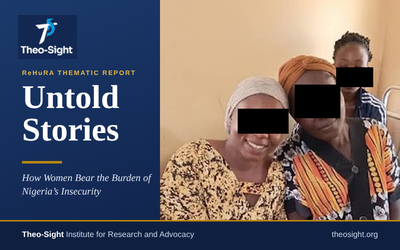
Untold Stories: How Women Bear the Burden of Nigeria’s Insecurity.
November 2026 · Theosight Media · Research for Advocacy Women rarely carry the guns in Nigeria’s rural conflicts, but they carry much of the cost. Theo-Sight’s fieldwork in Kwara, Kaduna, Plateau and Niger States shows women abducted from worship centres and farms, held in forest camps while (some) pregnant and nursing babies, and left as widows to raise children on land they can no longer safely farm. Government has taken important steps; this report sets out how they can reach the women who need them most. Key messages Women are prominent among those abducted in mass attacks. At Kurmin Wali and Woro most captives were women and children; at ECWA Omugo, five of the eight held were women. Captivity is especially dangerous for pregnant, nursing and elderly women. Survivors of the Woro abduction say six or seven women gave birth in captivity and lost their babies. Sexual violence is under-reported but present. Theo-Sight’s interviews contain warning signs, and human rights groups have reported allegations of rape in Kaduna camps in 2026. Widowhood and displacement are the long tail of the violence, and few of the widows Theo-Sight met had received public support. Government has rescued captives, provided post-release care in Kaduna and adopted strong laws and a national action plan. The task now is to bring that support to rural women. 1. Why this report, and how we gathered the evidence Theo-Sight’s earlier reports focused on attacks on places of worship, traditional rulers and children. Women appeared in every one of those investigations as most affected victims. This report brings their experiences together and provides them a voice to be heard. It draws on interviews by Theo-Sight’s Research on Human Rights and Advocacy (ReHuRA) project in more than 20 communities in Kwara and in Kauru and Kajuru LGAs (Kaduna), Bassa and Jos North (Plateau) and Munya and Shiroro (Niger) between 2024 and 2026, together with Theo-Sight’s published reports and verified reporting by civil society and the media. Every transcript was re-read for references to women and girls and coded by type of harm. Theo-Sight adheres to the stipulated standard of the Nigeria Data Protection Commission; names of private individuals are withheld or replaced with pseudonyms. 2. What happened to women The table lists incidents in Theo-Sight’s record in which women were killed, wounded or abducted. It is a record of documented cases, not a full count. Date and place What happened to women 17 Mar 2023 · Beni Ward, Munya LGA, Niger About 20 women and children kidnapped in a single raid. 13 May 2024 · Magure, Niger A pastor and his wife abducted; she watched him being beaten in captivity, where he died. 2024 · Kakude, Kauru LGA, Kaduna An elderly woman tied up with her husband and her eldest son killed; she was held for four to five months. A pastor’s wife was killed on the road. Apr 2025 · Zike, Bassa LGA, Plateau Many widows after the massacre, including pregnant girls of 16 and 17. 18 Nov 2025 · Eruku, Ekiti LGA, Kwara Women among 38 worshippers held for five nights; one young woman abducted for the second time. 31 Dec 2025 · Afin, Ile-Ire, Kwara The monarch’s wife shot in the hand during the raid on his palace. 18 Jan 2026 · Kurmin Wali, Kajuru LGA, Kaduna Most captives were women and children; pregnant and nursing women were held. A mother who escaped lost her two-week-old baby days later. 3–4 Feb 2026 · Woro and Nuku, Kaiama LGA, Kwara Two of the emir’s wives killed. Captives were mostly women and children; six or seven women lost babies born in captivity. 12 Mar 2026 · Oyatedo, Kwara A woman held for seven days learned only on release that her husband had been killed. 22 Mar 2026 · ECWA Omugo, Ifelodun LGA, Kwara Five of eight captives were women; two died, and the only three survivors were women. 29 Mar 2026 · Angwan Rukuba, Jos North LGA, Plateau Women shot; a mother held her son as he died; a woman shielding her son was spared. 5 Apr 2026 · Ariko, Kachia LGA, Kaduna Women among 37 abducted at Easter; births in captivity; allegations of sexual assault. 26–27 Apr 2026 · Gako, Riyom LGA, Plateau A pastor, his wife and two of their children killed at home. 25 May 2026 · Yashikira, Baruten LGA, Kwara The emir’s wives and children among about ten abducted. Women from affected communities. Eyes have been covered to protect their identity. Spotlight: women in captivity Kurmin Wali, Kaduna. “We were told not to run. They raised their guns and said nothing would happen,” said the wife of a pastor. Because her legs were weak, the captors later released her and her grandchildren, but her husband was taken. A mother who escaped with her two-week-old son watched him fall ill: “before I reached home, he died in my hands.” ECWA Omugo, Kwara. The captives included the pastor’s wife, a farmer’s wife in her eighties, a recently widowed woman of about sixty, a deaf woman and a young farmer’s wife. Two of the women died in captivity. The three people rescued alive in July 2026 were all women. Woro and Nuku, Kwara. Survivors of six months in captivity said about six or seven women gave birth in the camp and lost their babies. Magure, Niger. A church member recounted what a pastor’s wife told her after her release: “She watched her husband being tortured but could not help him because they were both captives.” Eruku, Kwara. Yemisi*, 20, was taken from a wedding convoy and then, weeks later, from her church: “It was painful for me to be kidnapped again during the church attack, and I recognised them as the same group of kidnappers.” 3. Analysis: five ways insecurity harms women A woman receiving hospital treatment. Her eyes have been covered to protect her identity. Figure 2. How rural insecurity harms women at each stage, as described in ReHuRA interviews. The harms build on one
Untold Stories: How Women Bear the Burden of Nigeria’s Insecurity. Read More »