
November 2026 · Theosight Media · Research for Advocacy
On 18 January 2026, 89 worshippers were abducted from three churches in Kurmin Wali, a farming village in Kajuru Local Government Area of Kaduna State. It was at least the twentieth attack on the village, and each earlier attack had ended with the community paying a higher ransom. This report sets out what happened, why the village remained exposed, what government has done, and the practical steps that would protect Kurmin Wali and communities like it.
| Key messages89 people were abducted, confirmed by a household check. Early reports, including the State Government’s figure of 183, were higher.The attack followed more than twenty earlier attacks, including 22 worshippers kidnapped the Sunday before.Ransoms rose almost ninefold in four years, from ₦300,000 in 2022 to ₦2.6 million, all raised from subsistence farmers.The village lacks the basics of protection: the nearest security post is 2 km away on a poor road, and there is no reliable phone signal, health facility, school or electricity.Government acted to bring the captives home and to care for them. The next step is to act on the first warning, not the twentieth. |
1. Why this report, and how we gathered the evidence
“We do not know who to cry to anymore,” Daniel*, a youth leader in Kurmin Wali, told researchers who visited his village after the attack.
Theo-Sight’s Research on Human Rights and Advocacy (ReHuRA) programme documents attacks on places of worship and rural communities so that the people affected are heard and the response is based on evidence. Kurmin Wali was chosen because it shows, in a single village, how repeated small attacks build towards a mass abduction.
Researchers from Theo-Sight and the Christian Awareness Initiative of Nigeria (CHAIN) visited Kurmin Wali on 3rd of March 2026. They interviewed survivors, their relatives, and community, church and youth leaders; documented the attacked churches; reviewed community registers and victim lists; and compared testimonies with reports by civil society and the media. Theo-Sight follows ethical guidelines stipulated by the Nigeria Data Protection Commission, and private individuals are not identified.
The field work brought clarification on the number of people affected. In the days after the attack, residents believed 177 people had been taken. When community leaders went house by house to confirm who had fled, hidden or been released on the day, the confirmed number of abductees was 89.
2. What happened in Kurmin Wali
Kurmin Wali lies in Afogo Ward of Kajuru LGA, about 80 kilometres from Kaduna. Its people are mainly Adara (Kadara) Christian subsistence farmers. Thick forest surrounds the village, and its neighbours, Gindin Gada to the west and Ungwan Wahala to the east, have been abandoned after repeated attacks. The table sets out the main events.
| Date | Place | Event |
|---|---|---|
| 2018 | Kajuru LGA | The Agom Adara, paramount ruler of the Adara, abducted and killed despite a ransom being paid |
| 2022–2024 | Kurmin Wali | Repeated abductions; the community pays ransoms of ₦300,000, ₦500,000 and ₦700,000 |
| Before 2026 | Gindin Gada and Ungwan Wahala | Both villages deserted after repeated attacks; residents say about ₦40 million paid in ransoms |
| 11 Jan 2025 | Kurmin Wali | 22 worshippers kidnapped; the community pays ₦2.6 million |
| 18 Jan 2026 | Kurmin Wali | Three churches attacked during Sunday worship; 89 people abducted |
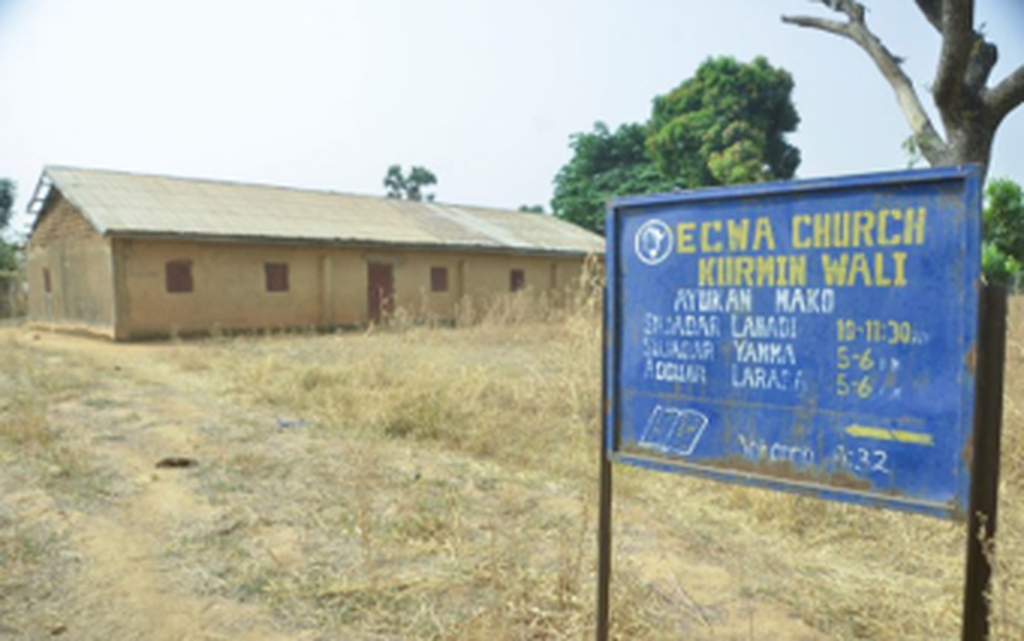
ECWA Church, Kurmin Wali, one of the three churches attacked on 18 January 2026. The service times are listed on the sign; the attackers struck during Sunday worship, when the community was gathered in one place. Photo: Theo-Sight.
| Spotlight: Sunday 18 January in Kurmin WaliThe attack. By 9 a.m., congregations had gathered at ECWA, Albarka C&S and Haske C&S churches when dozens of armed men on motorcycles stormed the village. “We were in the church when the warden rushed in shouting that bandits had surrounded the village,” said Samuel*, a Haske C&S worshipper. “People started running. But before we could escape, they were already there.”Deception and violence. “They raised their guns in the air and told us not to run. They said nothing would happen,” Samuel* said. The worshippers were marched into the forest and made to sit in an open field. “Without any reason, they began beating people with sticks,” said a 45-year-old man who suffered a serious head injury.Escape at Gindin Gada. As the captives were driven through the abandoned village, Rhoda* slipped away: “Since nobody lives there anymore, the houses were empty. I managed to sneak into one of the rooms with my child. I locked the door and stayed there for about two hours until everywhere became quiet.”The elderly. The wife of the Haske C&S pastor ran home, but “the bandits followed us. They broke the gate and took me and my three grandchildren,” aged ten to thirteen. Unable to keep up because of a chronic leg condition, she and other elderly captives were later released. Her husband was taken.Captivity. “They never kept us in one place,” a survivor said. “They kept moving us through the forest so nobody could find them.” Food and water were scarce. After about nine days, vehicles took the captives to Kaduna, where they received about two weeks of medical care. |
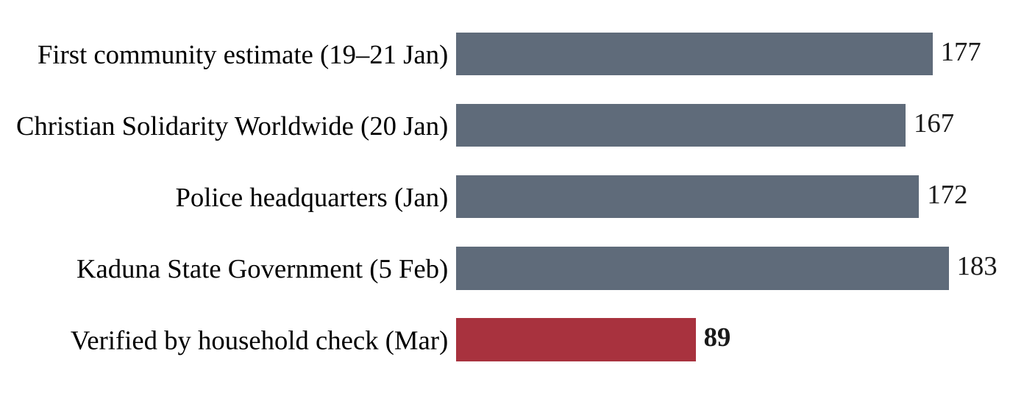
Figure 1. Reported number of people abducted from Kurmin Wali, by source and date. Grey bars show early or official figures; the red bar shows the number confirmed by community leaders after a household check in March 2026. Sources: Theo-Sight and CHAIN field visits; Christian Solidarity Worldwide; Nigeria Police Force; Kaduna State Government.
Figure 1 shows why early numbers in mass attacks must be treated with care. Every early figure was between 167 and 183; the verified figure is about half that, because people who fled, hid or were released on the day were at first counted as missing. The verified 89 is also the number the State Government said was freed in its final group on 4–5 February. The community’s list and the official list should now be reconciled so that a single agreed figure is on the record.
3. Analysis: four reasons Kurmin Wali remained exposed
- Repeated payment raised the price. “Each time they come, they kidnap people,” Samuel* said. “And we contribute money to pay ransom.” Figure 2 shows the result: the ransom rose by about ₦200,000 a year, then nearly quadrupled to ₦2.6 million one week before the mass abduction. Each payment showed that the village would pay more next time.
- Silence and broken trust. For years the community did not report attacks. “We don’t usually report such things, because we believe that everything is from God,” Samuel* explained. “But this one is too much. That is why we cried out.” Researchers also found a history of fractured relations between the village head and the local security agency, and the initial official description of the abduction as “mere falsehood” deepened that mistrust.
- Distance and slow response. The nearest security post is two kilometres away along a poorly maintained road. Residents say security forces sometimes arrive too late.
- A village without the basics. Kurmin Wali has no electricity, no primary or secondary school, no health facility, no reliable telephone signal and no good road. It cannot quickly call for help or treat its injured. Armed men are still seen moving with cattle in the surrounding forest: “When villagers see them, they run away,” the village head said. “If you don’t run, they may capture you.” Some families no longer sleep in the village at night, farmers avoid fields near the forest, and young people have left.
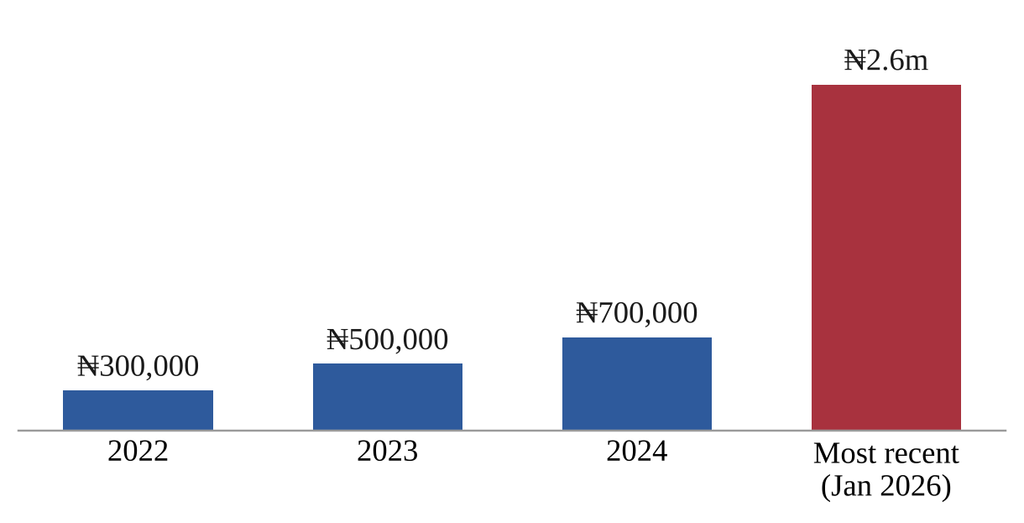
Figure 2. Ransoms paid by Kurmin Wali for abducted residents, as listed by the village head. The village head dated the ₦2.6 million payment to 2025; the CAN Afogo Ward chairman linked it to the abduction of 11 January 2026. The cost of the release of the 89 abducted on 18 January is not known to the community.
“We have tried to avert this, and we are tired of trying. We don’t know what next to do. Each time it happens, we pack our belongings to other villages. But we have to always return back, because we do not have any other place to run to.” — Daniel*, youth leader, Kurmin Wali
4. Government responses, remaining gaps and shared action
Theo-Sight acknowledges the response that brought the captives home. The table sets out what has been done, what remains, and how government, communities and partners can act together.
| Reported progress | Remaining gaps | Next steps for government | Community and partner roles |
|---|---|---|---|
| Police headquarters confirmed the abduction within a day and deployed tactical units to Kajuru. | The initial description of the reports as “mere falsehood” discouraged reporting and distressed families. | Adopt a protocol to acknowledge, verify quickly and update the public on mass-abduction reports. | Religious leaders and civil society share verified information promptly with authorities. |
| The captives were freed, received by the DSS and given about two weeks of medical care; the Governor received them publicly. | Figures differ (89 verified; 183 official). Follow-up trauma care in the village has not been reported. | Reconcile victim lists; provide follow-up medical and psychosocial care at home. | Churches provide pastoral and peer support; Theo-Sight shares its verified list on request. |
| A security post exists 2 km from the village. | Distance, a poor road, waiting for orders from higher command, and broken relations with the village head. | Move the post closer and strengthen it; allow immediate response to attacks. | Religious leaders or peace advocates convene the village head and commanders for joint training. |
| Local vigilantes act as the first line of defence. | No equipment, training or formal link to security agencies. | Provide communication devices and training; set up coordination channels. | The community nominates vetted volunteers who work under supervision. |
| The Governor publicly committed the Government to the community’s welfare. | No road, electricity, health facility, school or reliable signal. | Prioritise the access road, a health post, a school and a phone mast. | LGA and development partners support local projects. |
5. The legal and policy framework that protects worshippers and rural communities
Sections 33, 35 and 38 protect the rights to life, personal liberty and freedom of thought, conscience and religion, including the freedom to worship. The African Charter on Human and Peoples’ Rights (Articles 4, 6 and 8), part of Nigerian law, and the International Covenant on Civil and Political Rights (Article 18) protect the same rights. Under the Police Act 2020, the police must prevent and detect crime and protect life and property. Together, these place a clear duty on government to protect worshippers such as those at Kurmin Wali, to respond promptly when they are attacked, and to bring those responsible to justice.
6. Recommendations
- Religious leaders and peace advocates: convene the village head and local security commanders, and provide joint training to rebuild trust.
- Nigerian Army and Nigeria Police Force: revise operational rules so that personnel can respond immediately to an attack without waiting for orders from higher command.
- Kaduna State Government and security agencies: move the security post, now 2 km away on a poor road, closer to Kurmin Wali and increase its strength.
- Kaduna State Government and the Police: provide communication devices and training for community security volunteers, with formal coordination channels to security agencies.
- Army, DSS and Police: treat the forests around vulnerable villages as priority security zones, with regular patrols, intelligence gathering and surveillance.
- Kaduna State Government, Kajuru LGA and the NCC: provide an access road, a health facility, a school and a reliable phone signal.
- Federal Government and the Office of the National Security Adviser: adopt a national rural protection policy with permanent posts near high-risk villages, mobile rapid-response patrols and surveillance of forest corridors.
Theo-Sight believes that Kurmin Wali deserves an urgent attention because of its experience of repeated attack. Theo-Sight is willing to partner with relevant organisations to offer data driven model for rural security and protection.
Contributors: Dr Godwin Adeboye, Dr. Ayodele John Alonge, and Mercy Oloko T.
*Names marked with an asterisk are pseudonyms used to protect the identity of respondents.