
Kidnapping, banditry and rural violence are harming Nigeria’s children today and seeding the insecurity of tomorrow. Government has started to act; a coordinated rehabilitation and protection response can finish the job.
| Key messages Across Kwara, Kaduna, Plateau, Niger and Benue states, documented incidents in the twelve months to October 2026 include children abducted from religious centres and schools, killed at home and at a funeral, and bereaved by violence.Reports describe the abduction of children as young as two, alongside pregnant and nursing women; one captive reportedly gave birth in a forest camp.Government interventions have secured releases, and in Kaduna released captives received medical and psychosocial care. The cases reviewed indicate gaps in sustained, child-specific rehabilitation.Children affected by abduction, violence or the loss of a parent need sustained support to recover and continue their education. Rehabilitation protects their rights and can help rebuild trust in public institutions. |
1. Why this report, and how we gathered the evidence
This report examines how kidnapping and rural violence affect children and identifies policy priorities for their protection and rehabilitation. It draws primarily on Theo-Sight’s ReHuRA field documentation, including more than 100 semi-structured, consent-based interviews conducted between April and July 2026 with survivors, parents, clergy, traditional rulers, ransom negotiators and community security volunteers in Kwara, Plateau, Kaduna and Niger states. Fieldwork included site assessments and photography using GPS-tagged cameras. Interview testimony was supplemented and cross-checked, where possible, against Theo-Sight’s remote documentation, published survivor and escapee accounts, statements from the religious bodies and national media reporting—including Premium Times and Vanguard—and publications from UNICEF and the United Nations. Secondary sources also informed coverage of the Ariko and Benue cases, while incident-specific references distinguish field findings from externally reported information. Interviews followed survivor-centred, trauma-sensitive practices and the Nigeria Data Protection Commission’s requirements. All personal names used in this report are pseudonyms; locations and incident dates are retained. These selected cases illustrate reported harms and gaps in protection and support; they do not provide a national estimate of prevalence.
2. What happened to the children
| Date and place | What happened to children |
| 18 Nov 2025 · CAC Oke-Isegun, Eruku, Ekiti LGA, Kwara | Children aged about 5–10 and teenagers were among 38 worshippers held for five nights; captors reportedly demanded at least ₦20 million per person, including children. All were released on 23 November. |
| 21 Nov 2025 · St Mary’s School, Papiri, Niger | 303 pupils and 12 staff reportedly abducted from dormitories; about 50 escaped, and the remaining captives were reported freed by 21 December 2025. |
| 13 Dec 2025 · Dorong, Barkin Ladi LGA, Plateau | Four children of two families killed in a night attack, aged 3, 7, 9 and 17. |
| 18 Jan 2026 · Kurmin Wali, Kajuru LGA, Kaduna | Several people reportedly seized from three churches in 23 different kidnaping, mostly women and children, including children aged 2–13 and pregnant or nursing women. Twenty-four children were sent back; a two-week-old baby who escaped with her mother reportedly died days later. All remaining captives were reported freed by 5 February. |
| 3–4 Feb 2026 · Woro and Nuku, Kaiama LGA, Kwara | Schoolchildren reportedly among more than 200 people killed in communities and mosques; 163 people, mostly women and children, reportedly held for about six months and freed on 5 August. Some women returned pregnant. |
| 22 Mar 2026 · ECWA Omugo, Ifelodun LGA, Kwara | A baby carried on a captive’s back was taken, then left on a forest path and recovered; another fleeing child was rescued by a passing motorcyclist, according to the eyewitness’s account. |
| 5 Apr 2026 (Easter) · Ariko, Kachia LGA, Kaduna | Worshippers abducted from two churches. An escapee reported that a pregnant captive gave birth in the camp without medical assistance and that children had rashes and drank river water. Nigerian security personnel reportedly rescued 31 worshippers that day, while other victims remained in captivity for several months. |
| 26–27 Apr 2026 · Gako, Riyom LGA, Plateau | A pastor, his wife, son and daughter killed at home; two surviving children orphaned. |
| 16 Jun 2026 · Ungwan Magaji, Chawai, Kaduna | Gunmen fired on a funeral: four children aged 4–6 killed and four aged 4–9 wounded. |
| 11 Jul 2026 · Kum, Riyom LGA, Plateau | A family of nine killed at home, including a two-month-old baby. |
| Jul and Oct 2026 · Otukpo LGA, Benue | Women and children reportedly among at least 16 people killed at Otukpo-Nobi on 12 July; a four-year-old boy reportedly killed and his mother seriously wounded at Omulonye in October. |
Earlier attacks show the same pattern: at Yelewata, Guma LGA, Benue (13–14 June 2025), UNICEF reported a disproportionate number of women and children among about 200 dead; at Jebbu Miango, Plateau (30 May 2025), a girl of 12 or 13 was shot through her door.
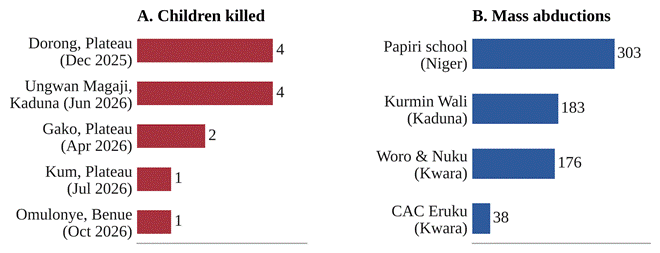
Figure 1. (A) Reported child deaths in five selected attacks, December 2025–October 2026. (B) Reported abductions involving children; counts include adults where reported and are not directly comparable child totals. Sources: Theo-Sight field data; press and government figures for Papiri, Kurmin Wali, Dorong, Kum and Omulonye. These selected cases are not regional or national totals.
| Spotlight: the children of Christ Apostolic Church (CAC), Eruku An earlier warning. Weeks before the attack, gunmen seized a wedding party and held two young people for about a month. One of them, Adunni*, 20, was abducted again from the church: “I recognised them as the same group of kidnappers.” The night of 18 November 2025. Gunmen surrounded the church as an evening praise service ended and marched 39 people into the forest, children as young as five among them. One young woman escaped in the dark. Captivity. The 38 were held in one spot for five nights, where “an insect… comes from the ground and enters people’s skin.” The negotiators estimated, from the telephone conversation, that one of the captors was no older than 15. After release. The state provided hospital care and several days’ lodging in Ilorin, which the community appreciated. Interviewees reported no subsequent counselling and described signs of distress among some children. Community members estimated that the congregation had declined from about 150 to 30–50 and that the town’s population had fallen to about 30% of its previous level. |
3. Analysis: four ways children are being harmed
- Children are exposed where families gather. The incidents above include attacks on a praise service at Eruku, Sunday worship at Kurmin Wali and Omugo, mosques at Woro, Easter worship at Ariko, a school dormitory at Papiri and a funeral at Ungwan Magaji. Protecting such settings requires cooperation between security agencies, community leaders, organisers and stakeholders.
- Ransom demands place children and families under severe pressure. At Eruku and Woro, captors reportedly demanded ₦20 million per captive, whether child or adult. “If one does a business, shouldn’t he make profit?” a kidnapper told the Eruku negotiator. Families reported selling land to meet ransom demands, reducing the resources available for children’s care and education.
- Mothers, newborns and pregnant women face particular risks. Pregnant and nursing women were reportedly held at Kurmin Wali, Ariko and Woro. At Ariko, an escapee reported that a captive gave birth without medical assistance and that a fellow captive cut the umbilical cord with her teeth. At Kurmin Wali, a two-week-old baby who escaped with her mother reportedly died days later. A two-year-old taken at Kakude, Kaduna, reportedly died in captivity.
- Interview accounts indicate unmet psychosocial needs. Respondents described children who could not sleep for days, a child “shaking in shock” in the bush, and a schoolgirl in Miango who “insisted that she was seeing a gun” where there was none. At Eruku, the community told us “there is nothing like” counselling. These accounts call for professional assessment and follow-up.
“She left four children and all of them are small small children; to pay school fees is a problem, to even feed them is a problem.” — Grace*, aunt of four children orphaned in Kwassam, Kaduna
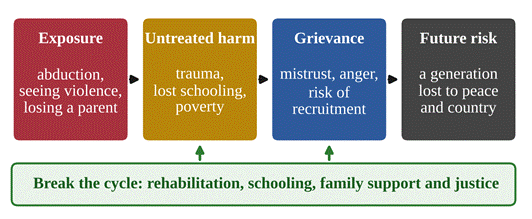
Figure 2. A proposed pathway linking exposure to violence, unmet recovery needs and possible longer-term risks. This is a policy illustration, not a finding that child survivors will become violent or join armed groups.
Children who survive abduction, witness killings or lose access to schooling need care in their own right. The accounts in this report do not establish how these experiences will affect their behaviour as adults. Sustained psychosocial care, education and family support can help recovery and rebuild confidence in public protection. The policy case is to support children’s futures without portraying survivors as future security threats.
4. Government responses, remaining gaps and shared action
Theo-Sight acknowledges reported rescue and care efforts. Government should lead sustained protection and rehabilitation, with communities and partners supporting prevention, referrals and follow-up.
| Reported progress | Reported gaps requiring follow-up | Recommended next steps | Community and partner roles |
| Papiri pupils and Woro and Nuku captives released. | No published recovery or school-return plan identified in the sources reviewed. | Fund post-release care and support school return. | Help families access services and support children’s return to learning. |
| Medical checks and psychosocial care provided for some victims in Kaduna State. | Eruku interviewees reported medical care without subsequent counselling and follow-up. | Establish minimum care standards and sustained follow-up. | Recognise distress, refer children to qualified services and prevent stigma. |
| Security personnel rescued Ariko worshippers; a joint operation freed remaining Omugo captives. | Other Ariko captives, including children and pregnant women, remained in captivity. | Address children’s and maternal health needs in rescue and post-release care. | Support safe family reunification and confidential referrals. |
| Security presence at Eruku; Forest Guards in Kwara and Operation Rainbow in Plateau. | Protection gaps at rural gatherings and schools; limited mobile coverage in some areas. | Strengthen protection and early-warning systems that work without mobile coverage. | Coordinate safe reporting and gathering arrangements with security agencies. |
| Child Rights Laws provide a protection framework. | No coordinated register identified; bereaved families reported unmet needs. | Maintain confidential case records and fund support for children who have lost parents. | Identify families needing help and connect them with welfare services. |
5. The legal and policy framework that protects children
Nigeria’s child-protection obligations extend beyond securing release from captivity. The UN Convention on the Rights of the Child, ratified by Nigeria in 1991, requires protection from violence and abduction (Articles 19 and 35) and support for recovery and reintegration (Article 39). Its Optional Protocol on children in armed conflict, ratified in 2012, prohibits recruitment or use of under-18s in hostilities by armed groups. The African Charter on the Rights and Welfare of the Child provides additional protections for children affected by armed conflict and internal strife (Article 22) and those deprived of parental care (Article 25).
In qualifying armed conflicts, the Geneva Conventions and Additional Protocol II prohibit hostage-taking and provide special protections for children. Under the Rome Statute, certain attacks on protected schools or religious buildings, and the recruitment or use of children under 15, may constitute war crimes; classification requires an armed-conflict nexus and the relevant offence elements. The Kampala Convention protects internally displaced people, while the Safe Schools Declaration expresses a political commitment to protect education during armed conflict. UN Security Council resolutions 1612 and 2225 provide for monitoring grave violations against children, including abduction, within a framework that covers Nigeria. Safely collected community evidence can support verification and appropriate referrals.
Domestically, sections 33–35 of Nigeria’s 1999 Constitution protect life, dignity and liberty, while section 17(3)(f) sets a child-protection policy objective whose enforceability differs from these fundamental rights. The Child’s Rights Act 2003 and applicable state Child Rights Laws provide further protections. Together, these instruments support action on prevention, rehabilitation, family care and continuity of education. Government should translate these commitments into funded, accessible services, with communities and partners supporting safe reporting, referrals and follow-up.
6. Recommendations
Priority: a coordinated national programme for children’s recovery.
Every child affected by abduction, witnessing violence or the loss of a parent should have access to psychosocial assessment and appropriate care, family support and a supported return to school, with follow-up for at least a year. The Federal Ministry of Women Affairs should coordinate with state social-welfare ministries and health and education authorities. Schools, churches, mosques and health centres can support referrals to qualified services. An initial phase should address the documented needs of children in Eruku, Ariko, Kurmin Wali, Papiri, Woro and Nuku, and bereaved families in Plateau and Benue, with published budgets and implementation timelines.
- Federal Ministry of Women Affairs and state governments: establish or strengthen confidential child-protection case records and support for children who have lost parents, covering school costs, food and a designated social worker, with safeguards for personal data.
- Ministry of Defence and security agencies: strengthen protection at gatherings involving children; adopt child-sensitive rescue and handover procedures, including immediate maternal and newborn care.
- Federal and state education authorities: support free enrolment and the return to learning of displaced and formerly abducted children, and reopen rural schools when protection arrangements are in place.
- Federal and state governments: publish verified, anonymised incident data by age and sex and report on rescue outcomes and post-release support, while protecting survivors and operationally sensitive information.
- UNICEF, faith bodies, and partners: support child protection and trauma services in affected areas, including North-Central Nigeria, and train teachers and religious leaders in psychological first aid and referral. Parents, community leaders and local organisations should help children access care, report concerns through safe channels and prevent stigma; these contributions support the state’s protection duties.
Theo-Sight is willing to discuss sharing appropriately anonymised field findings, subject to consent and data-protection safeguards, and to work with government, community partners and other relevant stakeholders on these recommendations. Sustained protection and recovery support can help children resume their education and rebuild their lives.
Contributors: Dr. Godwin O. Adeboye, Dr. Ayodele John Alonge, and Mercy Oloko T.
* Pseudonym. Sources: Theo-Sight ReHuRA field interviews (RHRA-KWR, KDN, PLT and NIGER series, 2026); Premium Times, 14 Dec 2025; AllAfrica, 26 Jan and 6 Feb 2026; Ripples Nigeria and The Guardian, 5–6 Apr 2026; Blueprint, 2 Jun 2026; Vanguard, 13 Jul and 9 Oct 2026; Channels TV, 21 Dec 2025; UNICEF Nigeria, Jun 2025; UN Secretary-General report S/2026/357.
/