
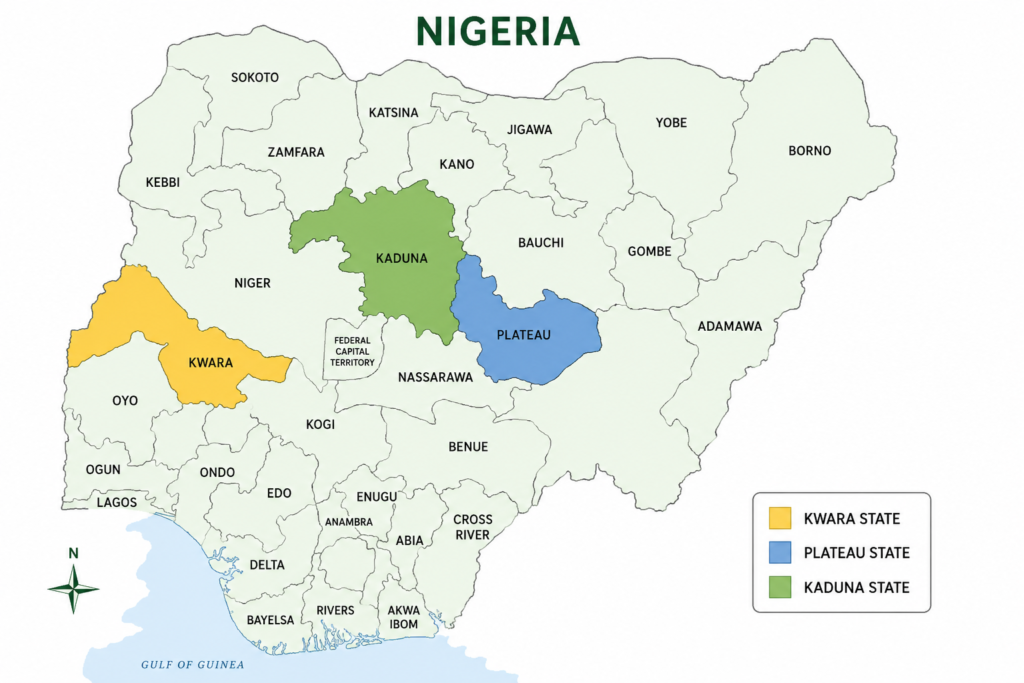
This submission documents a pattern of violent attacks targeting Christian places of worship in Nigeria, with particular focus on incidents in Kwara and Kaduna States between November 2025 and January 2026. Drawing on field-based investigations, survivor testimonies, and community-level data, the report argues that while Nigeria maintains a strong constitutional and international legal framework protecting freedom of religion, these protections are increasingly undermined by persistent insecurity, especially in rural areas. The submission seeks urgent attention from the UN Special Rapporteur on Freedom of Religion or Belief to the growing gap between legal guarantees and lived realities of religious freedom in Nigeria.
Legal Framework and State Obligations
Nigeria guarantees freedom of religion under Section 38(1) of the 1999 Constitution, which protects the right to manifest religion in worship, teaching, practice, and observance. Nigeria is also bound by international obligations, including:
- Article 18 of the Universal Declaration of Human Rights (UDHR)
- Article 18 of the International Covenant on Civil and Political Rights (ICCPR)
Under these frameworks, the Nigerian state has a positive obligation not only to respect but also to protect individuals and communities from violations by non-state actors, including armed groups.
Documented Incidents of Attacks on Worship Spaces
Eruku Church Attack, Kwara State (21 November 2025)
Armed assailants attacked a worship service at Christ Apostolic Church (CAC), Eruku, abducting 38 worshippers and killing two individuals. Ransom demands reportedly reached ₦100 million per victim.
ECWA Church Omugo Kidnapping, Kwara State (Date: March 22, 2026). Kidnapped victims are still held captive till now
On 22 March 2026, armed bandits attacked a Sunday worship service at ECWA Church, Omugo (Ifelodun LGA, Kwara State), abducting eight worshippers after opening fire on congregants. Subsequent ransom demands reached ₦1 billion, later reduced through negotiations.
Attacks on Ariko Christians during Easter worship
On 5 April 2026 (Easter Sunday), armed bandits attacked worshippers during live church services in Ariko, Kachia LGA of Kaduna State, targeting both ECWA and St. Augustine Catholic Church. At least 7–12 Christians were killed, and dozens of worshippers were abducted after gunmen opened fire on congregants within church premises.
Kurmin Wali Church Abductions, Kaduna State (18 January 2026)
On Sunday morning worship, armed groups simultaneously attacked three churches, ECWA, Albarka C&S, and Haske C&S, in Kurmin Wali (Kajuru LGA). Verified data confirms 89 worshippers abducted. Victims were beaten, marched into forests, and held under inhumane conditions before eventual release.
Key Findings
Targeting of Religious Spaces
Places of worship have become predictable and vulnerable targets, particularly in rural and peri-urban communities lacking security presence.
Emergence of a Ransom Economy Around Worship
The structured reduction of ransom demands—from ₦1 billion to ₦20 million—demonstrates the normalisation of economic exploitation of religious communities, transforming worshippers into financial assets for armed groups.
Failure of State Protection Mechanisms
Across all documented cases, common factors include:
- Absence of nearby security infrastructure
- Delayed or non-existent response during attacks
- Lack of early warning systems
- Poor rural access roads and communication networks
These constitute a systemic failure of the state’s duty to protect.
De Facto Restriction of Religious Freedom
Although no formal prohibition exists, fear has imposed practical limitations on worship, including:
- Reduced attendance at services
- Relocation or abandonment of churches
- Increased reliance on informal vigilante protection
This reflects a transition from legal freedom to constrained practice.
Accountability, Justice, and Public Transparency
While some arrests have been made in connection with attacks on worshippers, it is essential that these cases proceed to timely and thorough prosecution. Perpetrators must face appropriate legal consequences, and outcomes should be publicly communicated. Visible justice not only strengthens deterrence but also rebuilds public confidence in the state’s ability to protect vulnerable communities.
Analysis: Freedom of Religion Under Threat
The situation in Nigeria reflects a critical shift: freedom of religion is constitutionally guaranteed but operationally compromised. The consistent targeting of worshippers by non-state actors, combined with inadequate state response, constitutes a violation of Nigeria’s obligations under international human rights law. The state’s inability to secure places of worship, particularly in rural areas, amounts to a failure of due diligence, as defined under international human rights standards. Recommendations
We respectfully urge the UN Special Rapporteur to:
Engage the Government of Nigeria on the Rural Protection Policy
- Request a formal explanation of measures taken to protect places of worship in rural places
- Seek data on investigations, arrests, and prosecutions related to attacks on religious communities
Call for a National Protection Framework
Encourage Nigeria to establish a National Rural and Religious Site Protection Policy, including:
- Deployment of armed security personnel to high-risk worship centres
- Creation of rapid-response units for rural communities
- Surveillance and clearing of forest corridors used by armed groups
Promote Accountability Mechanisms
- Urge transparent reporting on ransom negotiations and rescue operations
- Strengthen prosecution of perpetrators of religious violence
Support Early Warning and Community Protection Systems
- Develop community-based early warning mechanisms
- Improve communication infrastructure in vulnerable regions
Conclusion
The evidence presented demonstrates that in Nigeria, the right to worship is increasingly exercised under conditions of fear, coercion, and insecurity. The persistence of attacks on churches, through killings, abductions, and ransom extortion, reveals a structural gap between legal commitments and lived realities. Without urgent intervention, the continued erosion of security around religious practice risks transforming freedom of religion from a guaranteed right into a conditional and dangerous activity.orming freedom of religion from a guaranteed right into a conditional and dangerous activity.