Digital Library

screenshot 2026 04 08 172237

Decolonised Hermeneutics of Lived Religion: Conceptualising Preaching in the Context of Ecological Sustainability

Abstract This study deals with the interface between decolonised hermeneutics of lived religion and ecological sustainability. It demonstrates that preaching becomes a transformative medium for ecological consciousness and justice when conceptualised through a decolonised framework. Beyond technological interventions, transformative shifts in values, behaviours, and policies have been recognised as essential for addressing ecological crises. In this regard, religion has emerged as a crucial force capable of inspiring and sustaining these deeper transformations toward ecological sustainability. However, despite the expanding scholarship at the intersection of religion, ecology, development, and sustainability, there remains a lack of clarity regarding how religion concretely contributes to ecological sustainability and which theoretical frameworks or contextual epistemologies best explain its role in this process. Drawing on Grab’s decolonised hermeneutics of lived religion, the study situates preaching as a contextual narrative capable of shaping environmental values and activism. The paper demonstrates that preaching, when decolonised, functions as a theological act of resistance against exploitative theologies and the commodification of nature, repositioning preaching at the centre of reimagining a participatory, justice-oriented, and earth-conscious future.
Decolonised Hermeneutics of Lived Religion: Conceptualising Preaching in the Context of Ecological Sustainability Read More »

on the significance of religion for human rights

ON THE SIGNIFICANCE OF RELIGION FOR HUMAN RIGHTS

This progressive volume furthers the inter-religious, international, and interdisciplinary understanding of the role of religion in the area of human rights. Building bridges between the often-separated spheres of academics, policymakers, and practitioners, it draws on the expertise of its authors alongside historical and contemporary examples of how religion’s role in human rights manifests. At the core of the book are four case studies, dealing with Hinduism, Judaism, Christianity, and Islam. Authors from each religion show the positive potential that their faith and its respective traditions has for the promotion of human rights, while also addressing why and how it stands in the way of fulfilling this potential.

ON THE SIGNIFICANCE OF RELIGION FOR HUMAN RIGHTS Read More »

george grima2

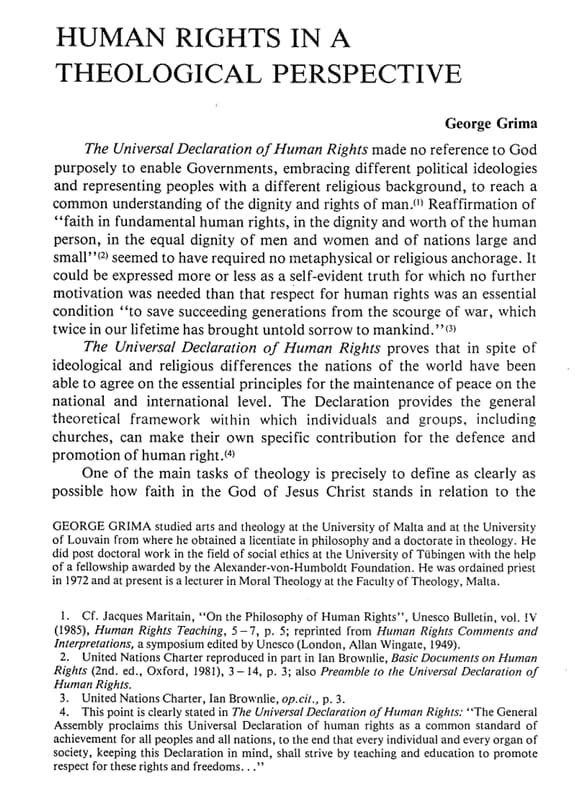
HUMAN RIGHTS IN A THEOLOGICAL PERSPECTIVE

The Universal Declaration of Human Rights proves that in spite of ideological and religious differences the nations of the world have been able to agree on the essential principles for the maintenance of peace on the national and international level. The Declaration provides the general theoretical framework within which individuals and groups, including churches, can make their own specific contribution for the defence and promotion of human right.<

HUMAN RIGHTS IN A THEOLOGICAL PERSPECTIVE Read More »

theological approaches to human rights

Theological Approaches to Human Rights

In this lesson we will discuss a Christian view on human rights and the call of Christians to be involved in advocating for human rights. We will first define what is meant by human rights. We will then consider the Biblical mandate for human rights involvement before looking at some objections that have been raised by Christians against the concept of human rights or human rights advocacy. Finally, we will summarise the distinctly Christian perspective on human rights.

Theological Approaches to Human Rights Read More »