Digital Library

HRVIATR Pdf 791x1024

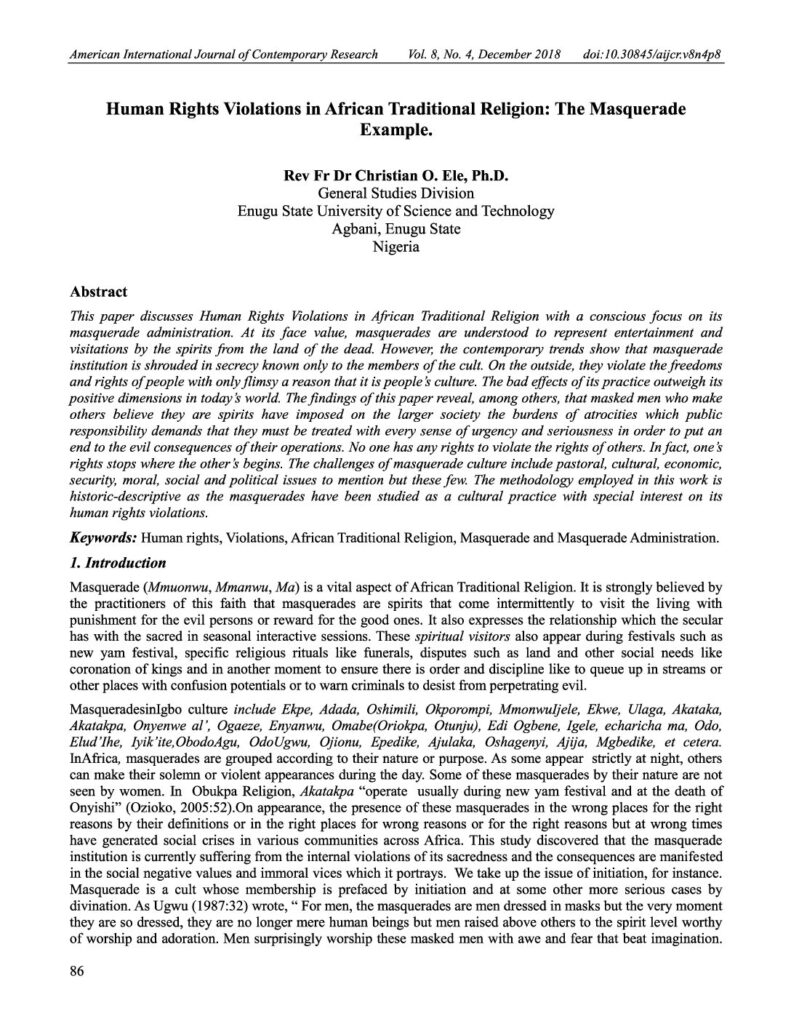
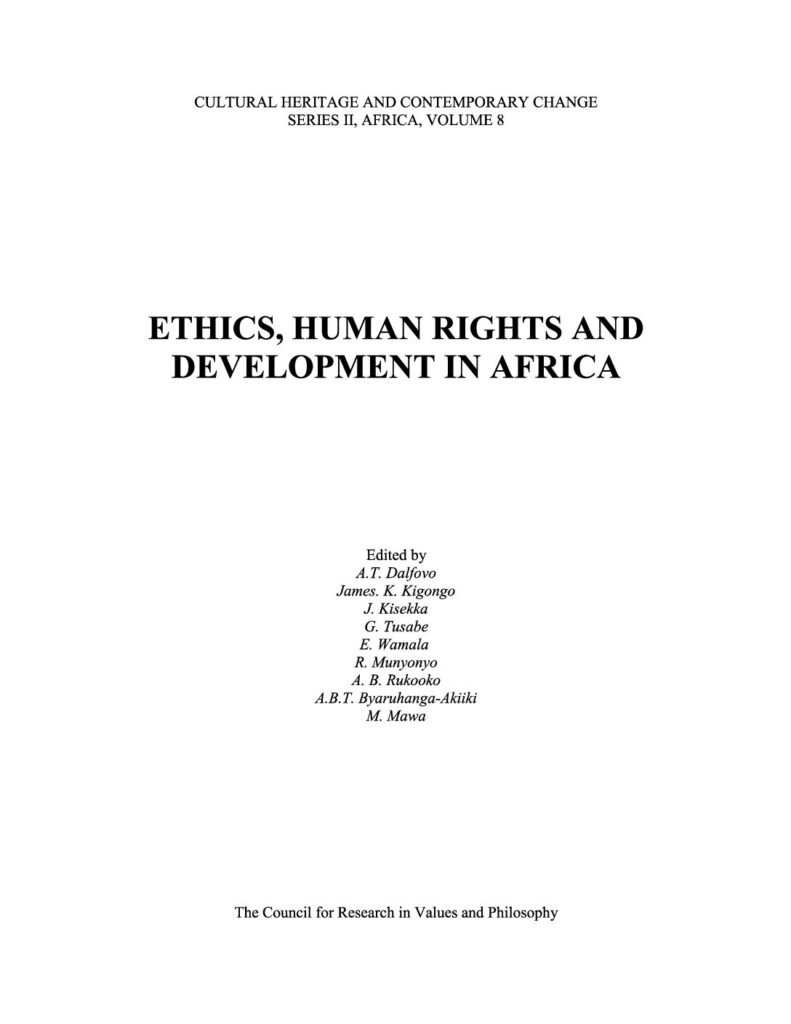
Human Rights Violations in African Traditional Religion: The Masquerade Example.

This paper discusses Human Rights Violations in African Traditional Religion with a conscious focus on its masquerade administration. At its face value, masquerades are understood to represent entertainment and visitations by the spirits from the land of the dead. However, the contemporary trends show that masquerade institution is shrouded in secrecy known only to the members of the cult. On the outside, they violate the freedoms and rights of people with only flimsy a reason that it is people’s culture. The bad effects of its practice outweigh its positive dimensions in today’s world. The findings of this paper reveal, among others, that masked men who make others believe they are spirits have imposed on the larger society the burdens of atrocities which public responsibility demands that they must be treated with every sense of urgency and seriousness in order to put an end to the evil consequences of their operations. No one has any rights to violate the rights of others. In fact, one’s rights stops where the other’s begins. The challenges of masquerade culture include pastoral, cultural, economic, security, moral, social and political issues to mention but these few. The methodology employed in this work is historic-descriptive as the masquerades have been studied as a cultural practice with special interest on its human rights violations.

Human Rights Violations in African Traditional Religion: The Masquerade Example. Read More »

AHRLJ Pdf 791x1024

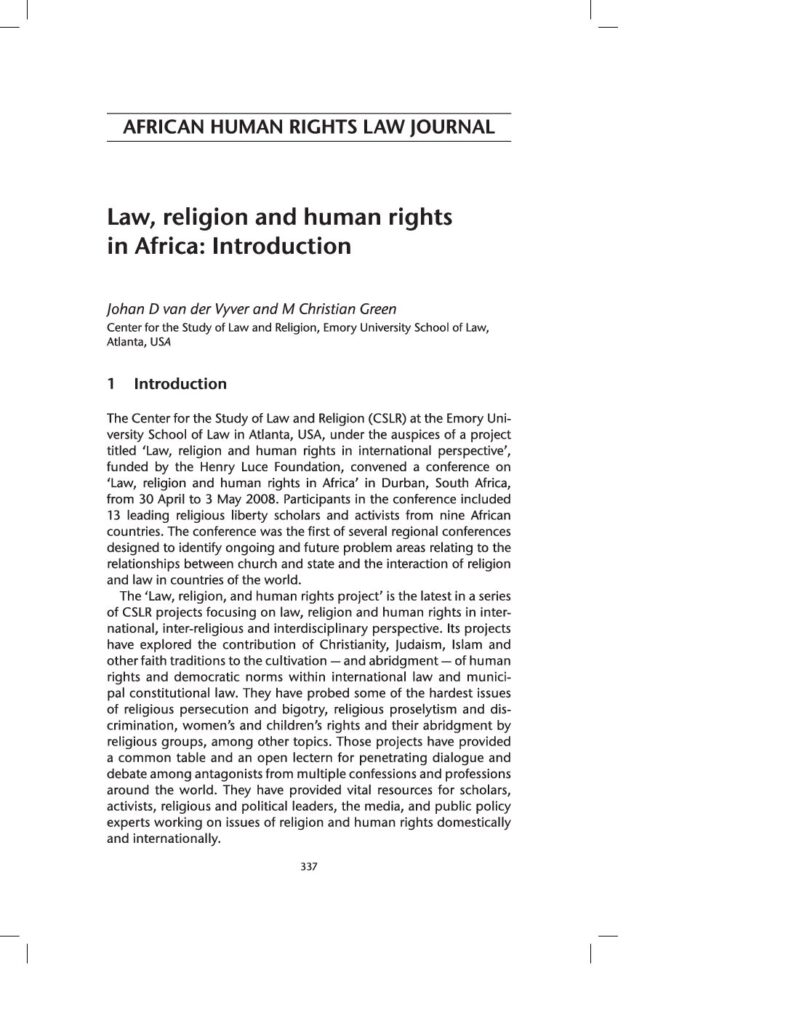
Law, religion and human rights in Africa: Introduction

The Center for the Study of Law and Religion (CSLR) at the Emory Uni- versity School of Law in Atlanta, USA, under the auspices of a project titled ‘Law, religion and human rights in international perspective’, funded by the Henry Luce Foundation, convened a conference on ‘Law, religion and human rights in Africa’ in Durban, South Africa, from 30 April to 3 May 2008. Participants in the conference included 13 leading religious liberty scholars and activists from nine African countries. The conference was the first of several regional conferences designed to identify ongoing and future problem areas relating to the relationships between church and state and the interaction of religion and law in countries of the world. The ‘Law, religion, and human rights project’ is the latest in a series of CSLR projects focusing on law, religion and human rights in inter- national, inter-religious and interdisciplinary perspective. Its projects have explored the contribution of Christianity, Judaism, Islam and other faith traditions to the cultivation — and abridgment — of human rights and democratic norms within international law and munici- pal constitutional law. They have probed some of the hardest issues of religious persecution and bigotry, religious proselytism and dis- crimination, women’s and children’s rights and their abridgment by religious groups, among other topics. Those projects have provided a common table and an open lectern for penetrating dialogue and debate among antagonists from multiple confessions and professions around the world. They have provided vital resources for scholars, activists, religious and political leaders, the media, and public policy experts working on issues of religion and human rights domestically and internationally.

Law, religion and human rights in Africa: Introduction Read More »

TROR Pdf 791x1024

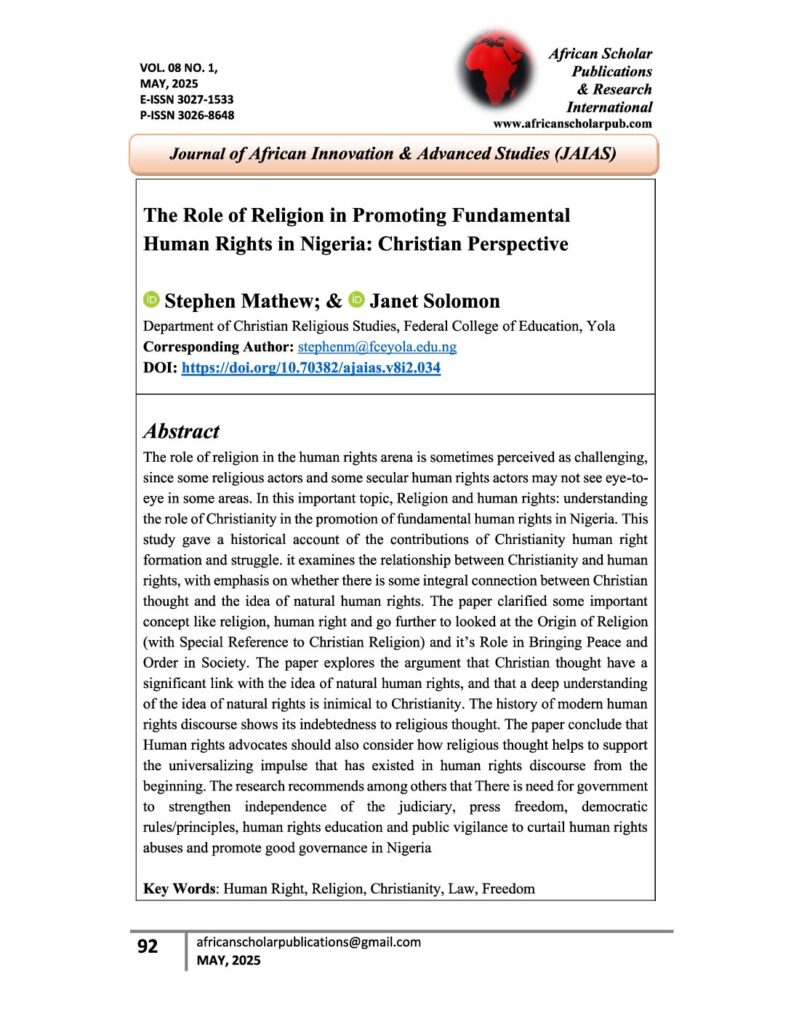
The Role of Religion in Promoting Fundamental Human Rights in Nigeria: Christian Perspective

Abstract The role of religion in the human rights arena is sometimes perceived as challenging, since some religious actors and some secular human rights actors may not see eye-to- eye in some areas. In this important topic, Religion and human rights: understanding the role of Christianity in the promotion of fundamental human rights in Nigeria. This study gave a historical account of the contributions of Christianity human right formation and struggle. it examines the relationship between Christianity and human rights, with emphasis on whether there is some integral connection between Christian thought and the idea of natural human rights. The paper clarified some important concept like religion, human right and go further to looked at the Origin of Religion (with Special Reference to Christian Religion) and it’s Role in Bringing Peace and Order in Society. The paper explores the argument that Christian thought have a significant link with the idea of natural human rights, and that a deep understanding of the idea of natural rights is inimical to Christianity. The history of modern human rights discourse shows its indebtedness to religious thought. The paper conclude that Human rights advocates should also consider how religious thought helps to support the universalizing impulse that has existed in human rights discourse from the beginning. The research recommends among others that There is need for government to strengthen independence of the judiciary, press freedom, democratic rules/principles, human rights education and public vigilance to curtail human rights abuses and promote good governance in Nigeria

The Role of Religion in Promoting Fundamental Human Rights in Nigeria: Christian Perspective Read More »

IEEC Pdf 791x1024

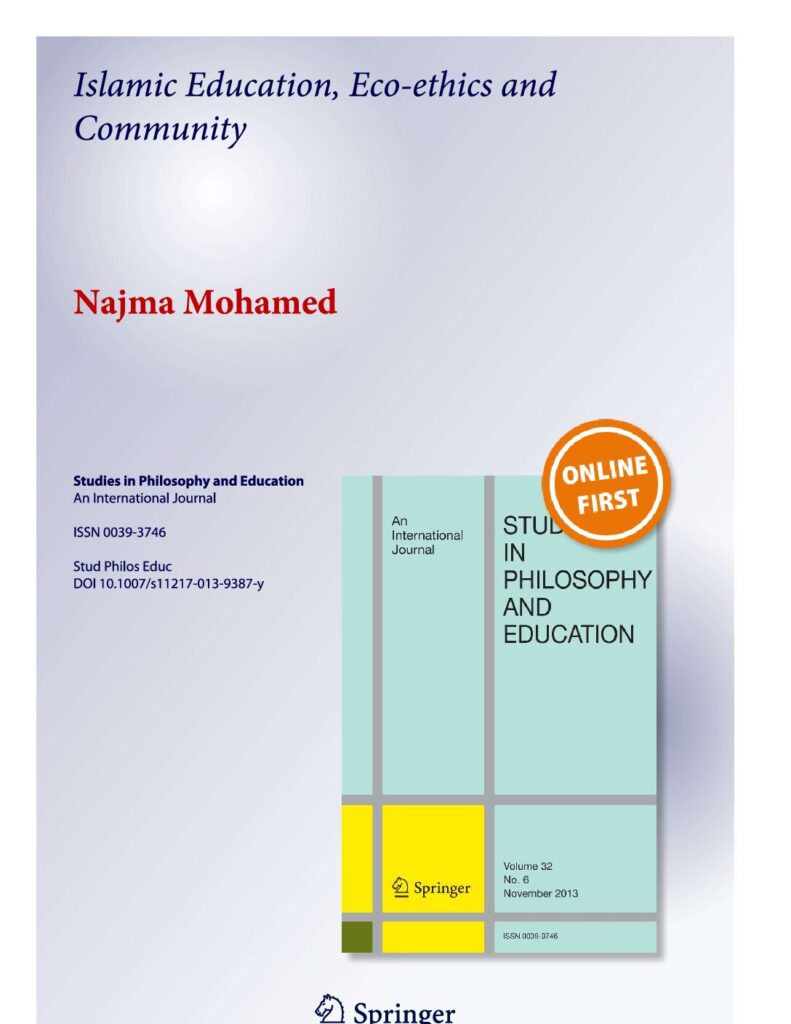
Islamic Education, Eco-ethics and Community

Your article is protected by copyright and all rights are held exclusively by Springer Science +Business Media Dordrecht. This e-offprint is for personal use only and shall not be self- archived in electronic repositories. If you wish to self-archive your article, please use the accepted manuscript version for posting on your own website. You may further deposit the accepted manuscript version in any repository, provided it is only made publicly available 12 months after official publication or later and provided acknowledgement is given to the original source of publication and a link is inserted to the published article on Springer’s website. The link must be accompanied by the following text: “The final publication is available at link.springer.com”.

Islamic Education, Eco-ethics and Community Read More »

The Theology of Peace and War in Old Testament and Its Relevance to Solving the Dilemma of Insecurity in Nigeria

INTRODUCTION Nigeria, as a multi-faith state, has been bedeviled devastatively with religious crises and civil unrest in recent time than any period in her national history. A lot of recommendations have been given to the country on her how to curtail the dilemma, all of which have proved irrelevant. A cursory look at Nigeria’s situation in this decade shows some similarities to the occasions of war in the Old Testament. The theology of war and national security in the Old Testament is relevant to our current dilemma of insecurity in Nigeria. In the Old Testament there were so much war and violence sanctioned by Yahweh.1 The Old Testament is full of reflections of warring activities in Ancient Israelite time. This is because there was what can be called ‘the spirit of territorial dominion cum nationalistic expressions.’ The horrific events of insecurity in Nigeria have served as a catalyst in making us to reflect on how one responds to such extreme actions of violence and insecurity. While some people advocated for swift military retaliation, on the other side of the spectrum, many proceeded to embark on ‘bizarre rituals of symbolic self- flagellation.’

The Theology of Peace and War in Old Testament and Its Relevance to Solving the Dilemma of Insecurity in Nigeria Read More »

Hilary Pdf 791x1024

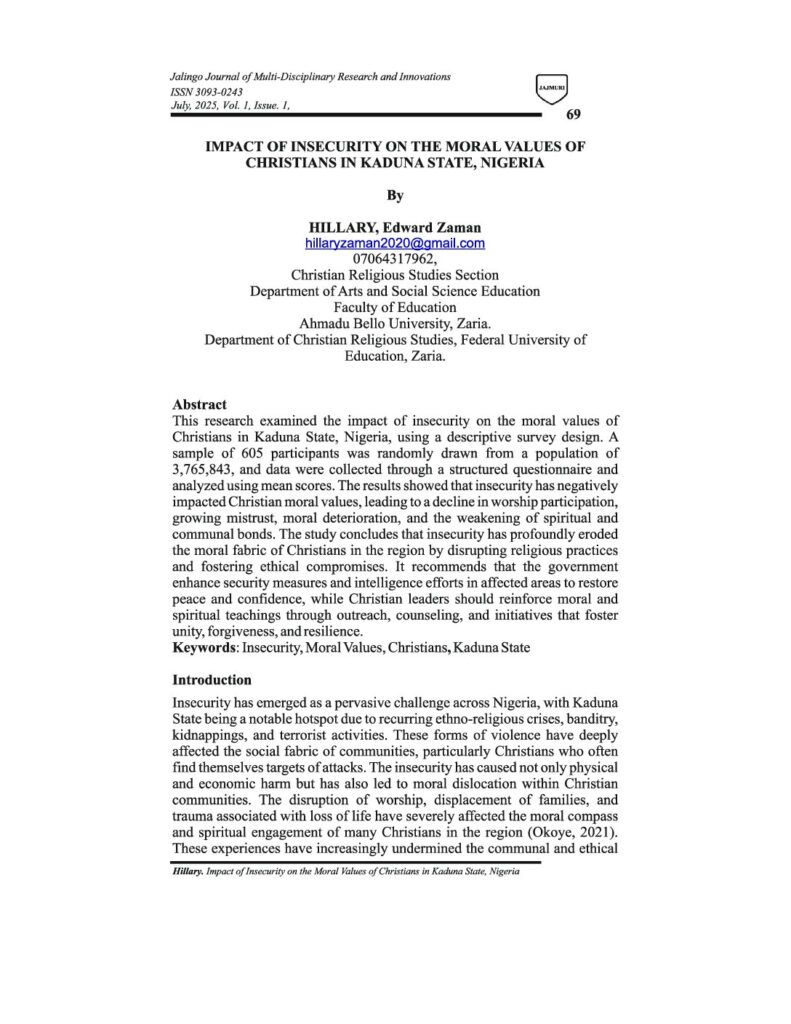
IMPACT OF INSECURITY ON THE MORAL VALUES OF CHRISTIANS IN KADUNA STATE, NIGERIA

Abstract This research examined the impact of insecurity on the moral values of Christians in Kaduna State, Nigeria, using a descriptive survey design. A sample of 605 participants was randomly drawn from a population of 3,765,843, and data were collected through a structured questionnaire and analyzed using mean scores. The results showed that insecurity has negatively impacted Christian moral values, leading to a decline in worship participation, growing mistrust, moral deterioration, and the weakening of spiritual and communal bonds. The study concludes that insecurity has profoundly eroded the moral fabric of Christians in the region by disrupting religious practices and fostering ethical compromises. It recommends that the government enhance security measures and intelligence efforts in affected areas to restore peace and confidence, while Christian leaders should reinforce moral and spiritual teachings through outreach, counseling, and initiatives that foster unity, forgiveness, and resilience.

IMPACT OF INSECURITY ON THE MORAL VALUES OF CHRISTIANS IN KADUNA STATE, NIGERIA Read More »

MCC Pdf 791x1024

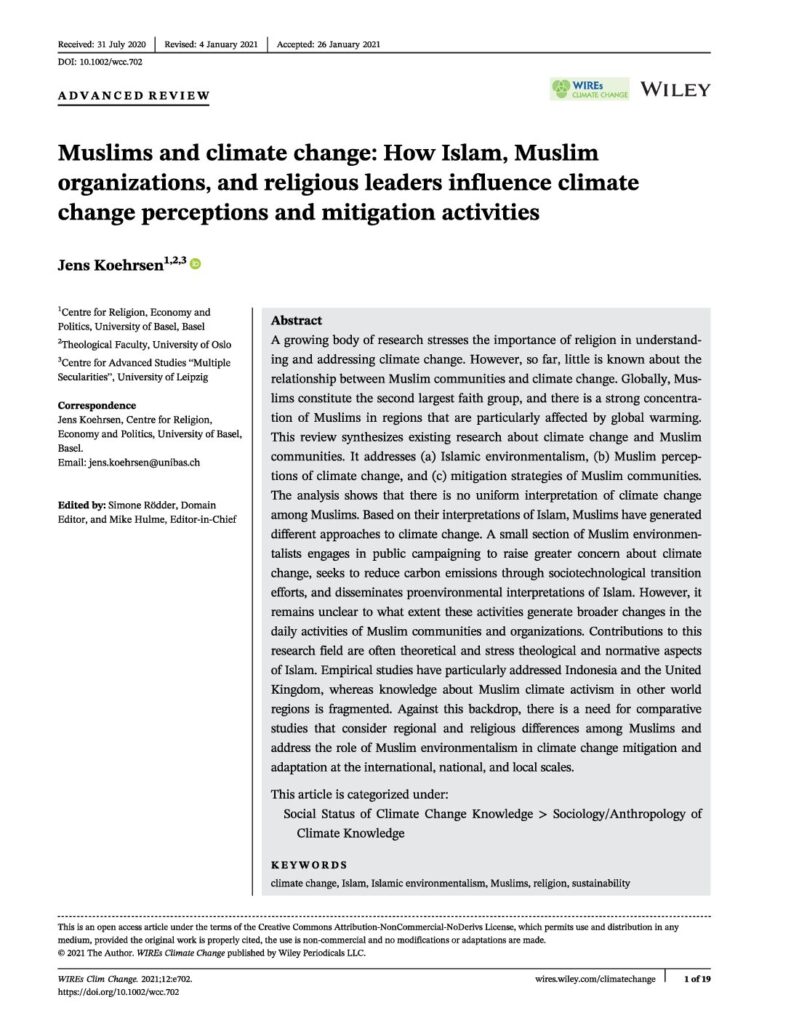
Muslims and climate change: How Islam, Muslim organizations, and religious leaders influence climate change perceptions and mitigation activities

A growing body of research stresses the importance of religion in understand- ing and addressing climate change. However, so far, little is known about the relationship between Muslim communities and climate change. Globally, Mus- lims constitute the second largest faith group, and there is a strong concentra- tion of Muslims in regions that are particularly affected by global warming. This review synthesizes existing research about climate change and Muslim communities. It addresses (a) Islamic environmentalism, (b) Muslim percep- tions of climate change, and (c) mitigation strategies of Muslim communities. The analysis shows that there is no uniform interpretation of climate change among Muslims. Based on their interpretations of Islam, Muslims have generated different approaches to climate change. A small section of Muslim environmen- talists engages in public campaigning to raise greater concern about climate change, seeks to reduce carbon emissions through sociotechnological transition efforts, and disseminates proenvironmental interpretations of Islam. However, it remains unclear to what extent these activities generate broader changes in the daily activities of Muslim communities and organizations. Contributions to this research field are often theoretical and stress theological and normative aspects of Islam. Empirical studies have particularly addressed Indonesia and the United Kingdom, whereas knowledge about Muslim climate activism in other world regions is fragmented. Against this backdrop, there is a need for comparative studies that consider regional and religious differences among Muslims and address the role of Muslim environmentalism in climate change mitigation and adaptation at the international, national, and local scales. This article is categorized under: Social Status of Climate Change Knowledge > Sociology/Anthropology of Climate Knowledge

Muslims and climate change: How Islam, Muslim organizations, and religious leaders influence climate change perceptions and mitigation activities Read More »