
Theosight Research

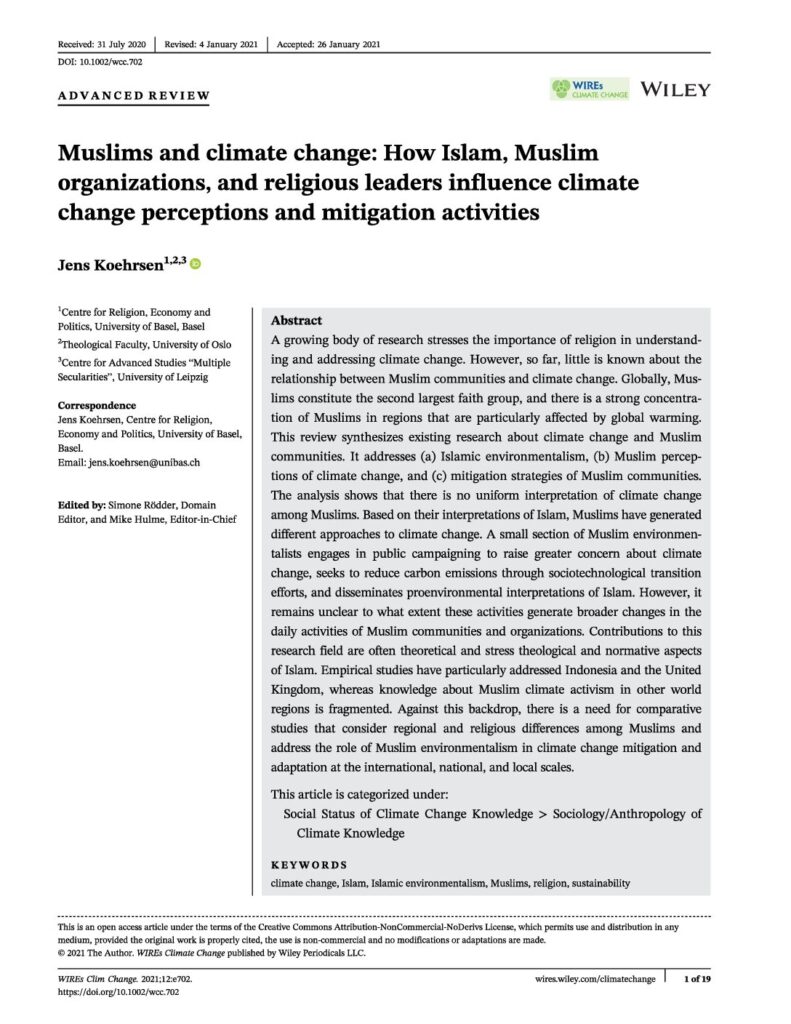
MCC Pdf 791x1024

Muslims and climate change: How Islam, Muslim organizations, and religious leaders influence climate change perceptions and mitigation activities

A growing body of research stresses the importance of religion in understand- ing and addressing climate change. However, so far, little is known about the relationship between Muslim communities and climate change. Globally, Mus- lims constitute the second largest faith group, and there is a strong concentra- tion of Muslims in regions that are particularly affected by global warming. This review synthesizes existing research about climate change and Muslim communities. It addresses (a) Islamic environmentalism, (b) Muslim percep- tions of climate change, and (c) mitigation strategies of Muslim communities. The analysis shows that there is no uniform interpretation of climate change among Muslims. Based on their interpretations of Islam, Muslims have generated different approaches to climate change. A small section of Muslim environmen- talists engages in public campaigning to raise greater concern about climate change, seeks to reduce carbon emissions through sociotechnological transition efforts, and disseminates proenvironmental interpretations of Islam. However, it remains unclear to what extent these activities generate broader changes in the daily activities of Muslim communities and organizations. Contributions to this research field are often theoretical and stress theological and normative aspects of Islam. Empirical studies have particularly addressed Indonesia and the United Kingdom, whereas knowledge about Muslim climate activism in other world regions is fragmented. Against this backdrop, there is a need for comparative studies that consider regional and religious differences among Muslims and address the role of Muslim environmentalism in climate change mitigation and adaptation at the international, national, and local scales. This article is categorized under: Social Status of Climate Change Knowledge > Sociology/Anthropology of Climate Knowledge
Muslims and climate change: How Islam, Muslim organizations, and religious leaders influence climate change perceptions and mitigation activities Read More »

screenshot 2026 04 08 172237

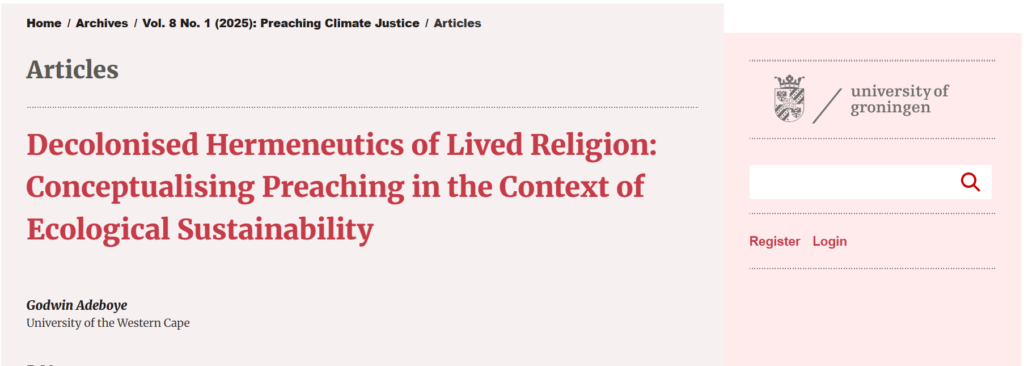
Decolonised Hermeneutics of Lived Religion: Conceptualising Preaching in the Context of Ecological Sustainability

Abstract This study deals with the interface between decolonised hermeneutics of lived religion and ecological sustainability. It demonstrates that preaching becomes a transformative medium for ecological consciousness and justice when conceptualised through a decolonised framework. Beyond technological interventions, transformative shifts in values, behaviours, and policies have been recognised as essential for addressing ecological crises. In this regard, religion has emerged as a crucial force capable of inspiring and sustaining these deeper transformations toward ecological sustainability. However, despite the expanding scholarship at the intersection of religion, ecology, development, and sustainability, there remains a lack of clarity regarding how religion concretely contributes to ecological sustainability and which theoretical frameworks or contextual epistemologies best explain its role in this process. Drawing on Grab’s decolonised hermeneutics of lived religion, the study situates preaching as a contextual narrative capable of shaping environmental values and activism. The paper demonstrates that preaching, when decolonised, functions as a theological act of resistance against exploitative theologies and the commodification of nature, repositioning preaching at the centre of reimagining a participatory, justice-oriented, and earth-conscious future.

Decolonised Hermeneutics of Lived Religion: Conceptualising Preaching in the Context of Ecological Sustainability Read More »

theological approaches to human rights

Theological Approaches to Human Rights

In this lesson we will discuss a Christian view on human rights and the call of Christians to be involved in advocating for human rights. We will first define what is meant by human rights. We will then consider the Biblical mandate for human rights involvement before looking at some objections that have been raised by Christians against the concept of human rights or human rights advocacy. Finally, we will summarise the distinctly Christian perspective on human rights.

Theological Approaches to Human Rights Read More »